How do I make sure someone finds out when the line goes down overnight?
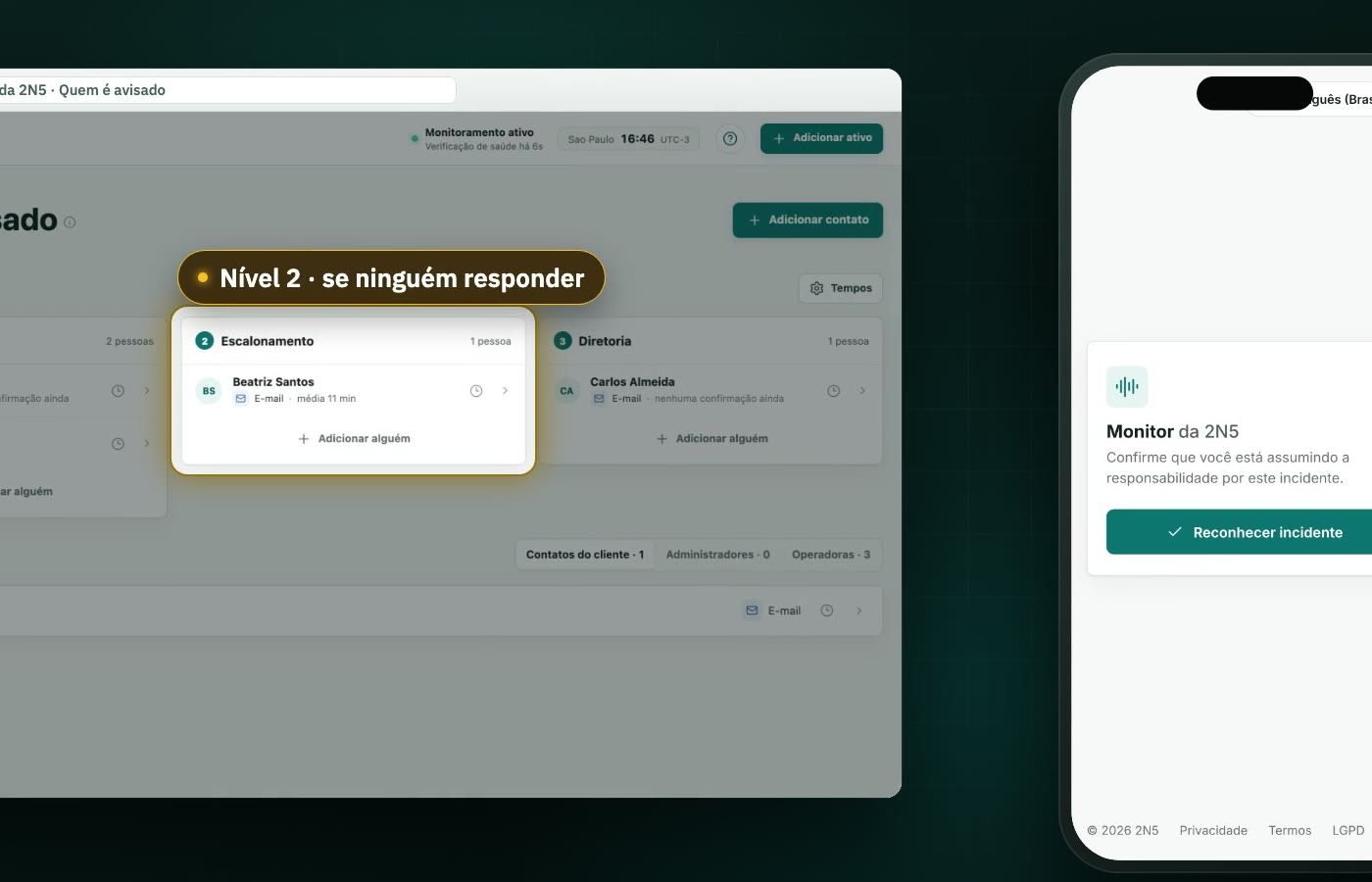
With an escalation ladder that does not stop until someone takes ownership. In Monitor, every confirmed incident notifies tier 1 by email. If nobody acknowledges within the agreed time, it notifies tier 2, then tier 3. A single acknowledgment, one tap on the email link, stops the escalation and records who took ownership. It is the line-down alert that arrives before the customer’s complaint.
What happens between the failure and the alert?
| Moment | What Monitor does |
|---|---|
| A test call fails | Retries the call at your pace; nobody is notified yet |
| Consecutive failures (four by default) | Opens an incident with the evidence: SIP codes, Q.850 causes, every call |
| Incident opened | Notifies tier 1 and the customer contacts, by email |
| Nobody acknowledged in time | Notifies the next tier, up to the last one |
| Someone acknowledges with a tap | Stops the escalation; the incident shows who and when |
| The circuit recovers | Closes the incident and tells the customer contacts it has been resolved |
The time to first acknowledgment goes into the SLA reports as the average response, to show how long the team takes to take ownership (see MTTR and MTTA).
Who is outside the ladder but still notified?
- Customer contacts: notified when a service has a problem, including poor voice quality, and when it is resolved. They are not part of the escalation.
- Administrators: notified when no tier acknowledges.
Why do only confirmed failures become alerts?
Because an alert at 2 a.m. has to be real, or the team stops paying attention. A one-minute blip, a route that failed once, or a problem on 2N5’s own side never wakes anyone up. When the fault is 2N5’s, the test is marked blind, does not count against the circuit, and 2N5 is the one that gets the notice. The guide to line-down alerts without false alarms explains the retest step by step.
Can alerts be silenced during maintenance?
Yes. A maintenance window covers the circuits you choose, at a scheduled time. During the window, failures on those circuits do not open an incident.
How does Monitor compare with other continuous testing services?
Retesting before alerting also exists in other continuous contact center testing services. See the comparison with the Hammer VoiceWatch alternative, with the source for every claim.
Frequently asked questions
How do I get alerts when a phone line goes down?
Register the person's email as a contact in Monitor by 2N5. When an incident is confirmed, a message arrives with the evidence and a link, and one tap on it confirms you have taken ownership. Each person can have more than one address, and the alert is sent only after the retest confirms the failure, never for a single call that failed.
How do I reduce false alerts in call monitoring?
By confirming the failure before alerting. In Monitor by 2N5, a failed call is retried, a retest before alerting, and only four consecutive failed calls, the first plus three retries, open an incident. A one-minute blip, a route that failed once and a problem on 2N5's own side never wake anyone up.
How do I know my phone lines are down before customers do?
By calling the number from the outside, around the clock, instead of waiting for a customer to complain. Monitor by 2N5 places a test call per circuit at the agreed pace, overnight included, and when the failure is confirmed it notifies the first tier of your ladder by email, with the SIP code, before the first complaint arrives.
Which channels do alerts come through?
By email, with the incident's evidence and codes and a link: one tap on it confirms you have taken ownership of the incident, without signing in to the system. The notice goes out only after the retest confirms the failure, and the first layer of the ladder receives it before the others.
What happens when someone acknowledges?
Escalation stops. One acknowledgment, one tap on the email link, is enough: the next tiers are not woken up, and the incident shows who took ownership and when. The time to that first acknowledgment also goes into the monthly report as the team's average response.
What if nobody acknowledges?
The alert moves up tier by tier, on the timing you set for each one. If no tier acknowledges, your company's administrators are notified. That way an overnight incident does not sit with a single person who never saw the message.
How do I avoid alerts during scheduled maintenance?
With a maintenance window for the affected circuits, at a scheduled time. During the window, failures on those circuits do not open an incident and nobody is woken up. Outside the window, monitoring returns to normal on its own, and a failure that continues is handled like any other.